



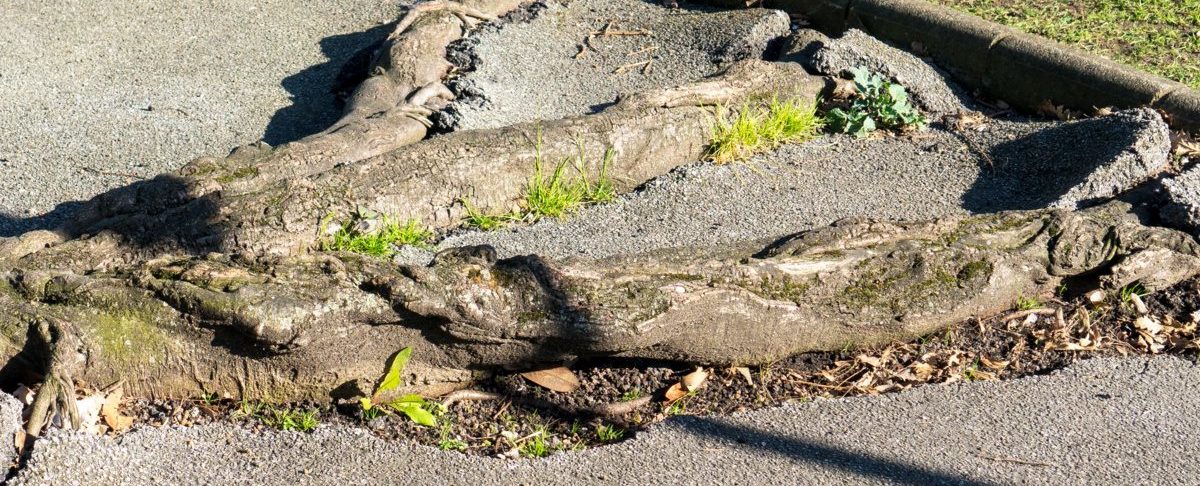
Sidewalks placed near mature trees often look great at installation, but create long-term performance challenges if site conditions are not carefully addressed. In Minnesota, tree roots, soil movement, and freeze–thaw cycles work together to stress concrete sidewalks, especially in landscaped areas around homes, schools, shopping centers, and multifamily properties.
Tree roots continue to grow long after installation, and without proper design and planning, they can lift slabs, disrupt drainage, and create safety risks. Understanding these challenges upfront helps property owners and managers reduce future repairs, maintenance costs, and liability exposure.
Challenge 1: Tree Root Growth and Soil Displacement
Tree roots expand outward and upward in search of moisture and oxygen. Roots take the path of least resistance; when soil is overly compacted (standard road base is often 95% compacted, which restricts root growth), they tend to occupy the space directly beneath the hardscape surface. As a result, sidewalks installed too close to root zones inevitably experience displacement beneath the slab.
How Roots Affect the Subgrade
As roots expand, they push soil upward or create voids when they decay. This movement destabilizes the base supporting the sidewalk, leading to uneven settlement or slab lifting over time.
Ignoring root behavior during planning often results in repeated repairs and shortened sidewalk lifespan. Planning with root movement in mind helps reduce recurring maintenance and extends the long-term performance of the sidewalk.
Challenge 2: Uneven Slab Lifting and Trip Hazards
One of the most visible consequences of root interference is uneven slab elevation. As roots expand beneath concrete, they can push sections of sidewalk upward or create voids that cause slabs to settle unevenly. These changes often develop gradually, making them easy to overlook until safety concerns or noticeable misalignment appear.
Safety Risks for Pedestrians
Raised edges and height differences between panels increase trip-and-fall risks, particularly in shaded areas where roots are common. In commercial settings, these hazards can lead to complaints, injuries, or liability claims.
Proper layout and control of slab movement are critical to maintaining safe walking surfaces.
Challenge 3: Drainage Disruption Around Root Systems
Roots alter how water flows beneath and around sidewalks. As root systems grow, they can redirect runoff, block natural drainage paths, or trap moisture beneath concrete surfaces. Over time, this disrupted water flow weakens the supporting soil and increases the risk of settlement and surface damage.
Water Pooling and Erosion Issues
When roots redirect runoff or block natural drainage paths, water can collect beneath slabs. Over time, this moisture erodes the base material, increasing the likelihood of settlement and surface cracking.
Drainage planning is especially important in Minnesota, where snowmelt and heavy spring rains place additional stress on concrete surfaces.
Challenge 4: Base Compaction Limitations Near Trees
Achieving proper base compaction near trees can be difficult without damaging root systems. Excavation depth and equipment access are often limited in landscaped areas, which can lead to uneven or insufficient compaction beneath the sidewalk. Without a stable, well-prepared base, slabs are more likely to shift as soil conditions change.
Restricted Excavation Zones
Contractors often face limited excavation depth or width near mature trees. Inadequate compaction beneath sidewalks leads to instability and uneven support, increasing the risk of movement as soil conditions change.
Balancing root preservation with structural integrity requires experience and site-specific solutions.
Challenge 5: Long-Term Maintenance and Repair Cycles
Sidewalks near trees typically require more ongoing attention. Even when installed correctly, continued root growth and seasonal soil movement can create gradual changes beneath the slab. These conditions increase the likelihood of periodic adjustments, repairs, or maintenance over the life of the sidewalk.
Increased Maintenance Expectations
Concrete sidewalk maintenance in landscaped areas often includes monitoring for lifting, cracking, and drainage issues. Even well-installed sidewalks may need adjustments over time as roots continue to grow.
Planning for care and maintenance for concrete sidewalk systems helps property owners avoid unexpected repair costs.
Challenge 6: Accessibility and Liability in Commercial Settings
Tree-related sidewalk movement presents added concerns in commercial environments. Properties such as shopping centers, schools, and multifamily buildings must maintain consistent, accessible walking surfaces for the public. Even minor slab displacement can raise compliance issues and increase liability exposure if left unaddressed.
Compliance and Risk Management
Commercial sidewalk installation must account for accessibility standards and consistent walking surfaces. Uneven slabs can create compliance issues for schools, shopping centers, and multifamily properties, increasing liability exposure.
Designing sidewalks with long-term accessibility in mind reduces risk and protects both users and property owners.
Challenge 7: Design Constraints in High-Traffic Areas
Sidewalks near trees often serve busy pedestrian zones. These areas experience constant foot traffic, which places additional stress on concrete surfaces already affected by root movement. Designing sidewalks that can accommodate both high use and natural growth patterns is essential for long-term durability and safety.
Balancing Durability and Aesthetics
In high-traffic locations, sidewalks must withstand constant use while accommodating natural elements. Design choices such as slab layout, joint placement, and routing around trees play a major role in long-term performance.
Thoughtful planning helps reduce stress points and prolong the service life of sidewalks in demanding environments.
Planning sidewalks near trees or landscaped areas requires careful consideration to reduce future lifting and cracking and associated safety risks. Through our concrete paving services in Minneapolis, Richfield Concrete helps property owners evaluate site conditions and design sidewalks built for long-term performance.
Why Choose Richfield Concrete for Concrete Sidewalks and Walkways
Installing sidewalks near trees, slopes, and landscaped areas requires more than standard construction methods. Long-term performance depends on understanding soil behavior, drainage patterns, pedestrian traffic, and how natural elements affect concrete over time.
Richfield Concrete brings decades of experience designing and installing sidewalks and walkways across Minnesota. Our team evaluates site-specific conditions before sidewalk installation begins, helping Minneapolis property owners avoid common issues such as slab lifting, drainage failures, and premature cracking. This approach is especially important for commercial and multifamily properties where safety, accessibility, and durability are critical.
When planning sidewalk and walkway projects, we focus on:
- Proper layout and joint placement to manage movement
- Stable base preparation suited for challenging soil conditions
- Drainage considerations to reduce erosion and settlement
- Long-term maintenance expectations for tree-adjacent sidewalks
Homeowners, property managers, and commercial clients choose Richfield Concrete because we provide clear guidance, proven installation practices, and solutions built for Minnesota’s climate. If your property includes mature trees or high-traffic walkways, our team can help you plan a sidewalk solution designed to perform safely and reliably over time.
Plan for Tree-Related Challenges Before Concrete Sidewalk Installation
Tree roots are a natural part of many landscapes, but they introduce ongoing challenges that cannot be ignored during sidewalk planning. Proper design, drainage consideration, and maintenance planning help reduce lifting, cracking, and safety concerns over time. Richfield Concrete works with homeowners, property managers, and commercial clients to evaluate site conditions and design concrete sidewalks that balance durability, safety, and long-term performance. If your project involves trees, slopes, or high-traffic walkways, contact Richfield Concrete today. Our team can help you plan a sidewalk installation built to handle Minnesota conditions with confidence.